How Git Solves Common File Storage Issues
Understanding Development Workflows Without Git: The Pendrive Issue
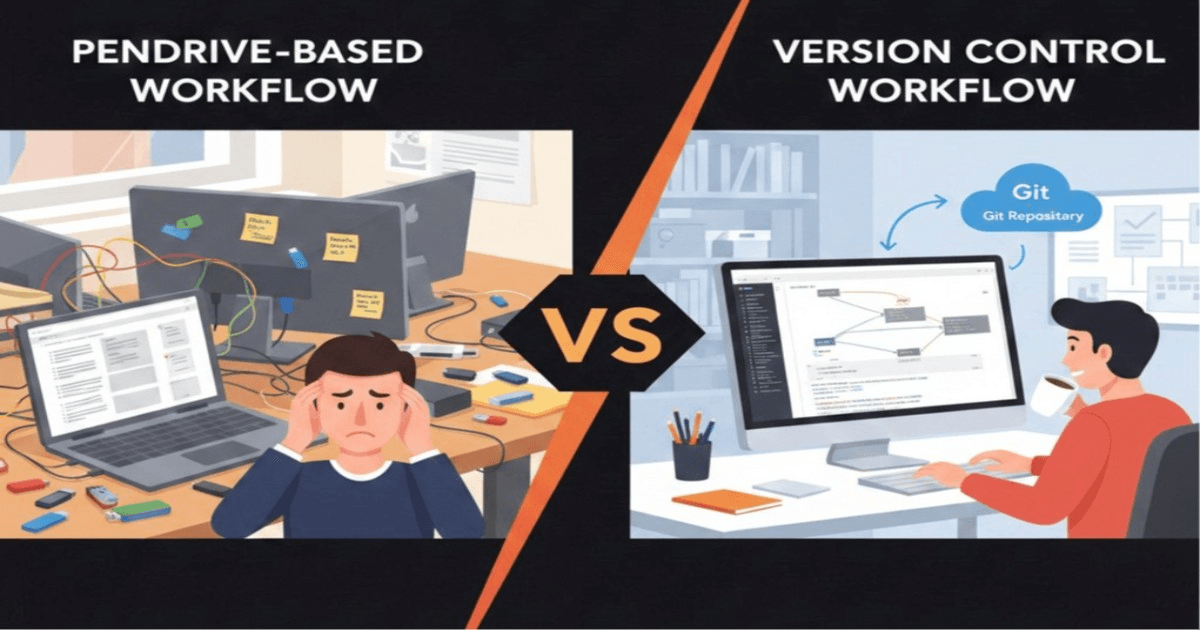
In today's rapidly evolving technological landscape, it has become increasingly apparent that every developer emphasizes the importance of learning Git. But why is mastering Git considered so crucial? To understand this, let's imagine attempting to build software without utilizing Git or any version control system.
Without Git, developers would face significant challenges in managing changes to the codebase. Collaboration among team members would become largely difficult, as there would be no efficient way to track who made specific changes or to merge contributions from different developers seamlessly. This could lead to conflicts and errors, as multiple versions of the code might exist without a clear way to reconcile them.
Moreover, without a version control system like Git, reverting to previous versions of the code in case of errors or bugs would be difficult or impossible. Developers would have to manually keep track of changes, which is not only time-consuming but also prone to human error. This could result in lost work and decreased productivity.
Git also provides a robust framework for branching and merging, allowing developers to experiment with new features or fixes in isolated environments without affecting the main codebase. This capability encourages innovation and reduces the risk of introducing bugs into the production environment.
Creating Software Without Git
In a company, there are often numerous developers collaborating on the same project. Without Git, they might have no better choice than using physical storage devices like USB drives to store and share the project's code. While USB drives are portable and can transfer data quickly, this method introduces several challenges. Each developer would need to manually copy the latest version of the code onto their drive, which could lead to inconsistencies if someone forgets to update their version (like final, final_v2, latest_final). Additionally, coordinating changes becomes difficult, as developers must ensure they are not overwriting each other's work. This process is not only time-consuming but also increases the likelihood of errors, such as accidentally losing important code changes or creating conflicting versions. Overall, relying solely on USB drives for code sharing in a multi-developer environment can significantly hinder productivity and collaboration.

So, imagine a scenario where Dev1 creates a new feature and saves it onto a USB drive as a version named final_v1. Then, Dev1 hands the USB drive to Dev2, who makes changes and adds another feature to the same drive as final_v2. This process continues as the USB drive is passed along to the next developer who needs to add their code. Each developer must wait their turn to access the USB drive, which can slow down the entire development process.
There's also a scenario where all developers are working on the same feature and they make changes in almost the same files. So, when combining the entire project code implementations of all the developers, there is a chance of overriding code or undetectable merge conflicts, which can cause unusual behavior of the project software or an outage, which can cost the company.

How Git solves the problems?
Git is a version control system which keeps tract of all the changes occurred in software from the beginning of project with the customization messages given by the developing team for marking the type of work done till. Git is developed by @Linus__Torvalds as side project for managing and keeping track of the Linux codebase.
Git is designed to efficiently track every single line of code that is changed across different branches of a project. Unlike traditional methods that might require duplicating the entire codebase, Git manages to do this without creating multiple copies of the code. This approach makes Git both lightweight and fast, allowing it to keep a detailed history of changes without consuming excessive storage space. Each change is recorded with precision, enabling developers to easily review, compare, and manage the evolution of their files over time. This capability is crucial for maintaining an organized and efficient workflow, especially in collaborative environments where multiple developers are working on different parts of the project simultaneously.
Short Comparison